AI load coverage — US brokerages
Ten carriers
in the time
you dial one.
2-minute form · then pick a time · 45-min video walkthrough
The guarantee $30,000 in new revenue, in 90 days Or every dollar back, including setup. See how →The moment a load tenders, eight AI agents go to work: they call and email your own carriers in parallel, post to the board network in the same second, negotiate inside limits you set, and bring a covered load back to your desk. Your people keep the relationships, the exceptions and the final word.
- Carriers / batch
- 10
- To full outreach
- <60s
- Agents on the desk
- 8
001 / 008The coverage engine
One tender. Everything fires at once.
A rep works a list in sequence — carrier one, carrier two, carrier three. The agents don’t queue. Every channel opens on the same tender, in the same second, and keeps going until something covers.
Ten carriers, at once
Not a list worked top to bottom — ten simultaneously.
Your own carriers, ranked by lane history, equipment and on-time record. Emailed and called in the same pass, not one after the other.
The boards, same second
The post doesn’t wait for outreach to fail.
It posts where programmatic posting is actually permitted — 123Loadboard, Direct Freight, Trucker Path, TruckSmarter, NextLOAD. Not DAT or Truckstop: their terms don’t allow a third party to post on your behalf, and your TMS already covers those. This works the channels your TMS leaves dark, while the phones are still ringing.
Then it escalates
Quiet for five minutes? The next ten go out.
No qualified carrier back yet, the system doesn’t sit there — it works a fresh batch of ten, up to three rounds, then hands you what it found rather than pretending it covered it.
Coverage clock
- 00:00Tender lands
- 01:0010 carriers worked + posted to boards
- 05:00Batch two, if it’s still quiet
- 10:00Batch three — then it reports back
Ten per batch, three batches, five minutes apart — the defaults. Every one of those numbers is a setting you control.
002 / 008How it thinks
Watch it get countered at $2,350 and close at $2,265.
Anything can dial a phone. The question is what happens when the carrier pushes back — so here is the whole decision, including the rules it runs on. These are the product’s actual rules, not a diagram of them.
- 1 Your lane historywhat you actually paid on CHI→ATL, last 6 loads MOST RELIABLE$2,180 avg
- 2 Live spot ratecurrent market, if you’ve connected a feed HIGH$2,240
- 3 Similar past loadsstructural match on equipment + lane MODERATE$2,205 avg
- 4 Imported benchmarksbaseline only — never decides on its own BASELINE$2,260
Your own book outranks the market. Target lands at $2,180. Your ceiling — the number you set, that it cannot cross — is $2,400.
- +06:38CARRIER
“I can do it for twenty-three fifty.”
- +06:38THE RULE IT USED
He’s $170 over target, which is inside the 10% band. Nothing countered yet, so: counter halfway. That’s $2,265.
- +06:41AGENT
“You ran this lane for us three times in the last sixty days. I can do twenty-two sixty-five and get you loaded today.”
- +07:02CARRIER
“Twenty-two sixty-five works. Send it over.”
- +07:04AGENT
Booked at $2,265 — $135 under your ceiling, $85 over your lane average. Rate con out, queued for a human to approve.
The rules it runs on — the defaults
- He asks at or under your targetTake it
- He’s over, but by less than 10%, and nobody’s countered yetCounter halfway
- He’s over by more than 10%Walk away
- Already countered once and he’s still overWalk away
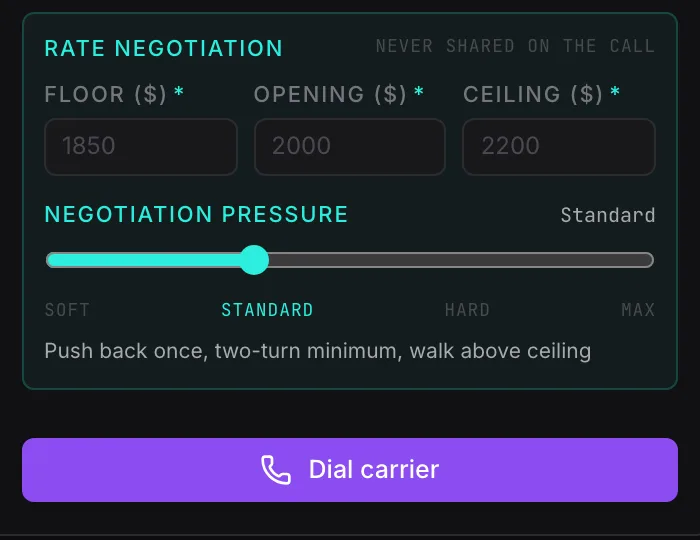
Four rules, and every number in them is yours — the band, the ceiling, how many rounds it goes, how hard it pushes. What you see here are the shipped defaults, not your settings, and no carrier can read them off this page and work out yours. It will not invent a fifth rule at 4pm on a Friday, and it never tells a carrier what your floor is.
Illustrative walkthrough on real rules and real rate logic, not a recording of a customer’s call — we don’t publish those without a signature.
003The guarantee
$30,000 or your money back.
If LoadHawk hasn’t generated $30,000 in new measurable revenue within 90 days of go-live, you choose what happens next. Not us.
Option A — full refund
Every dollar you have paid us comes back. The setup fee included — not just the monthly.
Option B — we work free
Rather keep the system than take the money? We stay on and keep running it with the monthly fee paused, zero invoices, until your books show the $30,000. However long that takes.
How it gets measured
- Source of truth
- Your TMS records — not our dashboard. If your TMS doesn’t show it, it doesn’t count toward our number.
- What counts
- Revenue from loads the system covered or brought back, logged from first carrier contact through signed rate con.
- The baseline
- Set against your 90 days before go-live, agreed in writing before we start — so neither side can move it later.
- Who decides
- You do. At day 90 you pick Option A or Option B. Both are written into the contract in the same words you’re reading.
$30,000 is a floor we put in a contract, not a projection we’d like you to believe — a commitment we make, not a forecast of your results. It assumes the things any deployment needs: read access to your TMS, and somebody on your side approving loads. Both are in the contract.
Read the full terms at /refunds before you book
004 / 008Run your numbers
What is slow costing you?
Four numbers you already know. Same model the free margin audit runs on — it counts three leaks, not one.
Leaking out of your desk
$17,365/ month
everything that hits your board
the spread, not the linehaul
bounced, gone quiet, or covered by someone faster
anyone dialling carriers or chasing paperwork
Leaking out of your desk
Leaking $17,365 a month
- Margin on loads that slipped
- 4.8 loads a week that never moved
- $3,949
- Desk time on manual work
- dialling, check calls, chasing PODs
- $9,114
- Detention nobody invoiced
- sat long enough to bill across 239 covered loads — billed to the shipper, most of it owed onward to the carrier
- $4,302
That’s $67 off every load that hits your board.
What LoadHawk gets back
$2,962
New margin
$7,747
Desk freed
$3,442
Detention billed
$14,150a month
$42,451in 90 days
What this model suggests
$30,000
We guarantee your number, not a brochure number — capped at $30,000 and rounded down to a figure that fits in a contract. Miss it and you get every dollar back.
Read the units carefully, because they differ. The contract measures revenue on loads the system covered, reconciled in your TMS — the New margin column above, $2,962 a month, or $8,885 across the 90 days the guarantee runs. Freed desk hours and recovered detention are real money, but they are cost and cash, not revenue, and they do not count toward the guarantee. We would rather you knew that now than argued about it on day 90.
Assumptions, both directions, so you can argue with all of them. Leak: 4 manual hours per person per day at $35/hr loaded, $18 of uninvoiced detention per covered load. Recovery: 75% of slipped loads caught, 85% of that desk time back, 80% of the detention invoiced. Estimates, not measured results — and the numbers to push on when we run this on your real figures.
45-minute video walkthrough · your loads, your margins, exact pricing in writing
005 / 008Watch it work
Don’t take our word for it. Look at it.
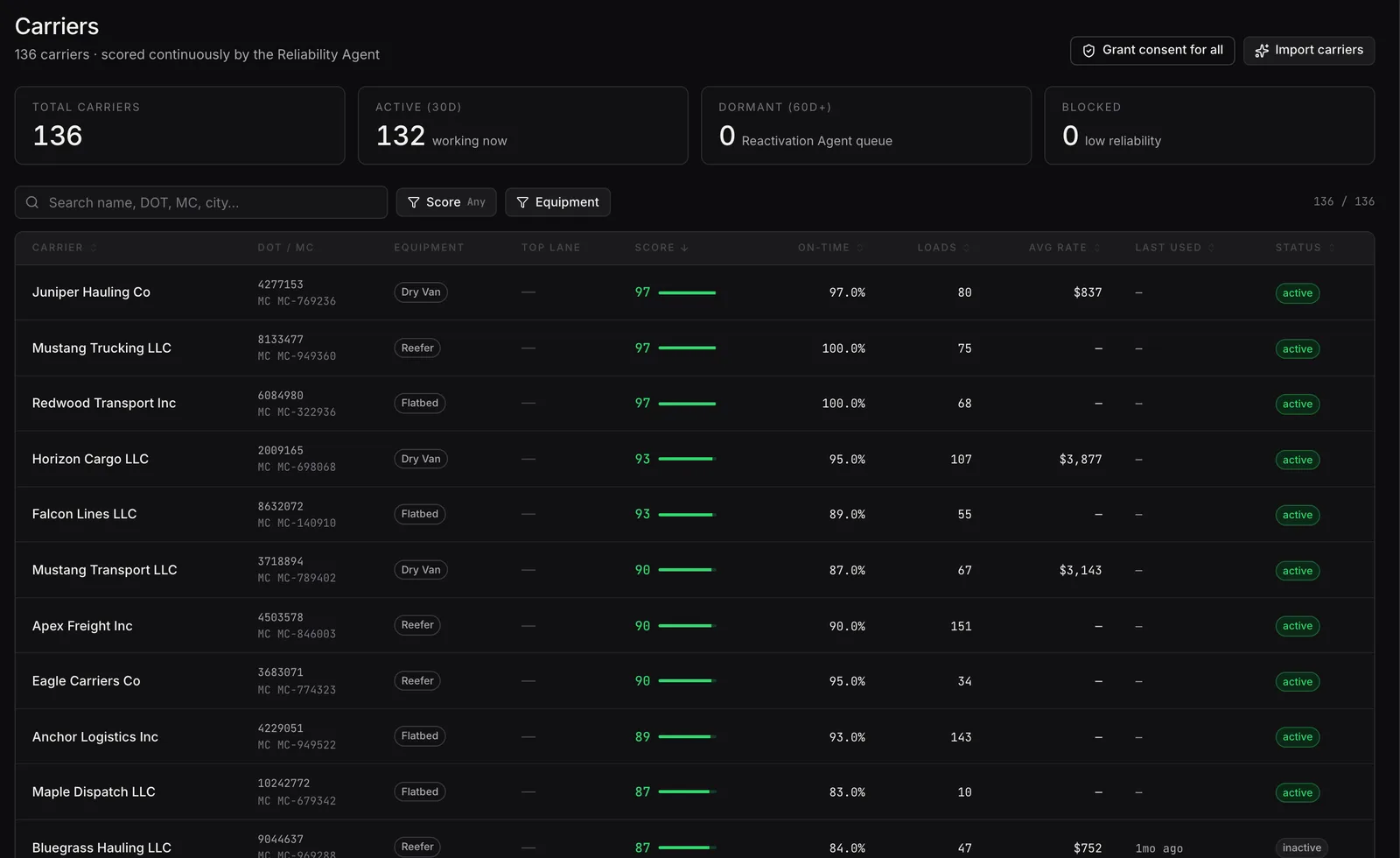
Unedited captures from the live LoadHawk environment on seeded sample data — we don’t put a customer’s book on a marketing page. On your call it runs on your lanes, in the same dashboard.
006 / 008Your grip on it
It answers to you, and it says so out loud.
The two questions owners actually ask are “will this embarrass me in front of my carriers” and “if it books a bad carrier, am I the one holding it?”. Nobody in this category answers them on their website. Here are ours, with the rule behind each.
It never pretends to be human
Ask it straight out and it tells you. That instruction is hard-coded into every call script — carrier, shipper and broker — not a setting somebody can switch off: “Yeah, I’m an AI assistant calling on behalf of [your brokerage] — a human here signs off on whatever we agree.”
Recording disclosed by default
The default announces the recording on every call, in every state — the setting your counsel will almost certainly want. You can narrow it, but recording law turns on where the person actually is, not on their area code, so we ship it on.
It starts on manual
Out of the box every load is manual: the agents do the work and queue the result for a human to approve. Autonomy is something you switch on, load by load or across the board, once you’ve watched it enough to trust it. Nobody at our end can flip it for you.
It won’t offer a load to a carrier that fails your screen
Authority has to be active and the insurance filing has to be on record — $1M auto liability, $100k cargo as standard. Conditional or Unsatisfactory safety rating: blocked. Any BASIC at or above FMCSA’s intervention threshold — 65% on Unsafe Driving, Hours-of-Service or Crash Indicator, 80% on the rest — flags before it ever offers the load.
By design, it will not
- NOBook above the ceiling you set — even by a dollar
- NOTell a carrier your floor, your ceiling, or your customer’s rate
- NOMove a load whose carrier failed vetting
- NOKeep dialling after you pause the desk
- NOPretend to be a person, on any call, ever
Outside its rules it stops and hands the load to your rep with the full call history attached, rather than guessing and telling you afterwards. A carrier who asks it to stop calling stops it permanently, across every load. Every check it ran sits in the audit log — the record you want if anyone asks how that carrier was chosen. Carrier selection stays your call and your responsibility; we make it faster and we make it provable.
007 / 008Built for
Is this right for your shop? Straight answer.
This is for you if
- You run a US-based freight brokerage
- You lose loads because your team can’t respond fast enough
- You have real, repeating load volume
- You want more volume without adding headcount
This is not for you if
- You operate outside the United States
- You’re looking for free — LoadHawk has a setup fee and a monthly fee
- You want the AI running unattended from day one; it ships gated behind approvals
Straight talk on price
LoadHawk isn’t free and the price isn’t a secret formula: it’s a one-time setup fee plus a flat monthly fee — never a percentage of your loads, never a per-minute meter. The exact numbers depend on your volume and which agents you run, so you get them on the call once we’ve scoped your lanes, and you leave with them in writing. Whatever the figure, it sits under the same guarantee.
Who built it
Haarith Imran
Founder, STRUCTURE
Years inside logistics operations, and years building AI systems that run in production rather than slide decks about them. LoadHawk wasn’t assembled from white-label parts — it was architected agent by agent around one observation: brokerages don’t lose loads on rate, they lose them on minutes. Every deployment is set up by hand around your lanes.
2-minute form · 45-minute video call · exact pricing on it
008 / 008Straight answers